
California Accuses State Farm of Mishandling Los Angeles Wildfire Claims: What Policyholders Should Know
 When Californians purchase homeowners insurance, they are paying for financial protection during some of the most devastating moments they may ever experience. After a wildfire destroys or contaminates a home, policyholders should be able to expect a prompt investigation, clear communication, and payment of all benefits reasonably owed under their policies.
A recent enforcement action by the California Department of Insurance raises serious questions about whether State Farm met those obligations while handling claims arising from the January 2025 Eaton and Palisades fires.
On May 4, 2026, the Department announced that it had filed an Accusation and Order to Show Cause against State Farm General Insurance Company. Regulators allege that the insurer repeatedly delayed investigations, underpaid policyholders, mishandled smoke-damage claims, and failed to communicate adequately with wildfire survivors. State Farm denies that it engaged in a general practice of mishandling or intentionally underpaying claims.
The administrative proceeding has not yet established State Farm’s liability in every cited claim. However, the allegations provide an important reminder that insurance companies must comply with California’s claims-handling laws even when responding to a widespread catastrophe.
What Did California Regulators Find?
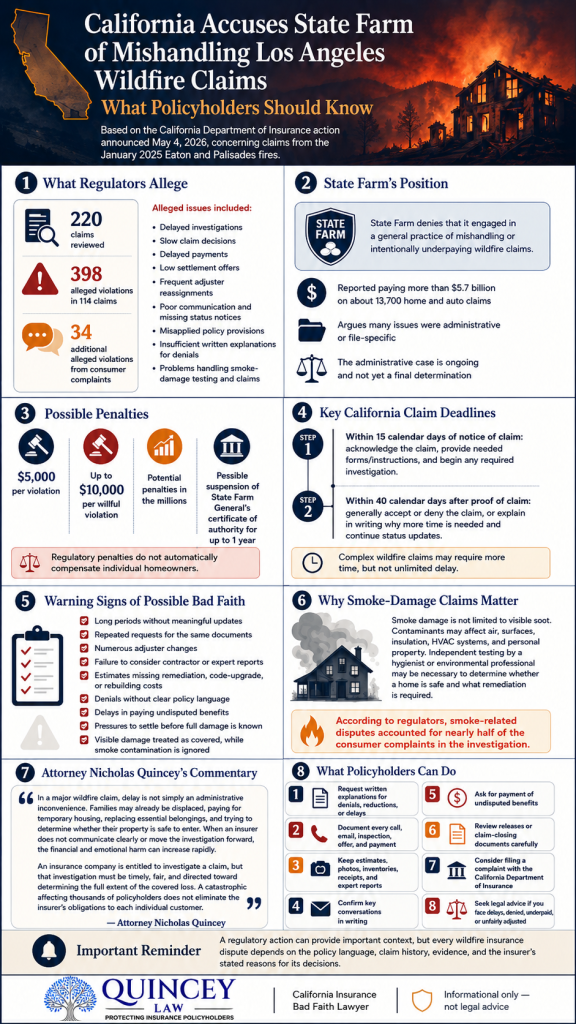
The Department examined a sample of 220 State Farm claims connected to the Eaton and Palisades fires. According to the Department, examiners identified 398 alleged violations of California law in 114 of those claims. Some files reportedly contained several separate violations.
The Department’s enforcement filing also includes 34 alleged violations identified through individual consumer complaints. The allegations involve conduct that regulators say included:
- Failing to begin claim investigations within required timeframes.
- Taking too long to accept or deny claims.
- Delaying payments after coverage had been accepted.
- Making unreasonably low settlement offers.
- Reassigning claims among numerous adjusters.
- Failing to respond to policyholder communications.
- Neglecting to send required claim-status notices.
- Misrepresenting or incorrectly applying policy provisions.
- Failing to provide written explanations for certain claim denials.
- Denying or misclassifying expenses for hygienist and environmental testing related to smoke contamination.
The Department characterized the alleged conduct as a pattern of delay, denial, underpayment, and unnecessary bureaucracy. It is seeking corrective action for unresolved claims in addition to financial penalties.
“In a major wildfire claim, delay is not simply an administrative inconvenience. Families may already be displaced, paying for temporary housing, replacing essential belongings, and trying to determine whether their property is safe to enter. When an insurer does not communicate clearly or move the investigation forward, the financial and emotional harm can increase rapidly.
An insurance company is entitled to investigate a claim, but that investigation must be timely, fair, and directed toward determining the full extent of the covered loss. A catastrophe affecting thousands of policyholders does not eliminate the insurer’s obligations to each individual customer.” Attorney Nicholas Quincey explained.
State Farm Disputes the Allegations
State Farm has denied that it followed a general practice of intentionally mishandling or underpaying wildfire claims. The company has described many of the disputed issues as administrative, procedural, or specific to individual claim files.
State Farm also reported that it had paid more than $5.7 billion on approximately 13,700 home and auto claims connected to the fires. It criticized the potential license suspension sought by regulators and argued that such action could further destabilize California’s homeowners insurance market.
These defenses will be addressed through the administrative process. The filing of an accusation is the beginning of that process rather than a final determination that every alleged violation occurred.
An administrative law judge may hear evidence, evaluate the Department’s allegations and State Farm’s responses, and recommend appropriate findings or penalties. The Insurance Commissioner may then impose penalties after the hearing process.
What Penalties Could State Farm Face?
California Insurance Code Section 790.035 permits penalties of up to $5,000 for each violation of the state’s unfair claims laws. That amount can increase to as much as $10,000 for each violation found to be willful.
Based on the number of alleged violations, State Farm could potentially face penalties totaling several million dollars. The Department is also seeking authority to suspend State Farm General’s certificate of authority for up to one year, which could temporarily prevent it from writing new policies in California.
A regulatory penalty, however, does not automatically compensate an individual homeowner for every loss caused by a delayed or underpaid claim. Policyholders must still evaluate their own claims, policy language, communications, damages, and the reasons provided for the insurer’s decisions.
California Insurers Have Deadlines for Handling Claims
Insurance companies may need additional time to investigate complicated wildfire losses, particularly when a property has been completely destroyed or may contain smoke, asbestos, lead, or other hazardous contaminants. Complexity does not give an insurer unlimited time to act.
California’s Fair Claims Settlement Practices Regulations establish several important claims-handling deadlines. After receiving notice of a claim, an insurer generally must acknowledge the claim, provide necessary forms or instructions, and begin any required investigation within 15 calendar days. The insurer must also respond to communications that reasonably require a response within the applicable deadline.
After receiving proof of claim, an insurer generally has 40 calendar days to accept or deny the claim in whole or in part. When the insurer cannot make that decision within 40 days, it must provide a written explanation describing why additional time is necessary and continue sending status notices while the investigation remains open.
California Insurance Code Section 790.03 also identifies several forms of potentially unfair claims conduct, including:
- Failing to acknowledge and act reasonably promptly on claim communications.
- Failing to establish reasonable standards for investigating and processing claims.
- Failing to accept or deny coverage within a reasonable time.
- Failing to attempt a prompt, fair, and equitable settlement when liability is reasonably clear.
- Misrepresenting material facts or policy provisions.
- Failing to provide a reasonable explanation for a denial or compromise offer.
- Forcing policyholders to pursue litigation by offering substantially less than the amount ultimately determined to be owed.
Whether a delay or denial is unreasonable depends on the facts of the particular claim. Nevertheless, insurers are expected to investigate objectively rather than search only for information that supports denying or minimizing payment.
When Can Mishandling a Wildfire Claim Become Insurance Bad Faith?
Not every disagreement over the value of a claim constitutes insurance bad faith. An insurer may reasonably dispute coverage or the cost of repairs when the policy language or available evidence supports a genuine disagreement.
Bad faith may arise when an insurer unreasonably withholds benefits, conducts an inadequate or biased investigation, disregards evidence supporting coverage, delays payment without a legitimate explanation, or interprets the policy in a way that unfairly deprives the policyholder of promised benefits.
California law implies a covenant of good faith and fair dealing in every insurance policy. An insurance company must not take unreasonable steps that interfere with its policyholder’s right to receive the benefits of the agreement.
The California Supreme Court has held that an insurer cannot reasonably deny benefits without thoroughly investigating the factual basis for its decision. An inadequate investigation may therefore support a claim for breach of the implied covenant of good faith and fair dealing.
Potential warning signs in a wildfire insurance claim may include:
- Long periods without meaningful communication.
- Repeated requests for documents the policyholder has already provided.
- Numerous adjuster changes without a proper transfer of information.
- Refusal to consider reports from contractors, hygienists, engineers, or environmental professionals.
- Estimates that omit necessary demolition, remediation, code-upgrade, or rebuilding expenses.
- Denials that do not identify the specific policy language supporting the decision.
- Delays in paying undisputed portions of a covered loss.
- Pressure to accept a settlement before the full extent of the damage is known.
- Treating visible structural damage as covered while refusing to investigate potentially dangerous smoke contamination.
The overall claim history matters. A seemingly minor missed deadline may not establish bad faith by itself. A continuing pattern of inadequate investigation, unexplained delay, misleading communication, and underpayment may present a much different legal issue.
Why Smoke-Damage Claims Are a Major Part of the Investigation
Smoke damage is not always limited to visible soot or an unpleasant odor. Smoke and ash may carry hazardous materials into insulation, ventilation systems, furniture, carpeting, walls, personal belongings, and other areas of a home.
Determining whether a property can be safely occupied may require testing by an industrial hygienist or another qualified environmental professional. That testing can help identify contaminants and determine whether cleaning, removal, remediation, or replacement is necessary.
According to the Department, smoke-related disputes accounted for nearly half of the consumer complaints involved in its investigation. Regulators allege that State Farm failed in some cases to provide required written denials for hygienist or environmental testing, incorrectly classified testing expenses, or misrepresented policy language concerning inspections.
A policyholder should not assume that the absence of direct flame damage means there is no covered loss. Coverage depends on the policy language, the cause and extent of the contamination, the evidence obtained during the investigation, and other claim-specific circumstances.
Does a Violation of the Claims Regulations Automatically Create a Lawsuit?
California’s unfair claims statutes authorize the Insurance Commissioner to investigate insurers and pursue administrative enforcement. The California Supreme Court has held that Insurance Code Section 790.03 does not, standing alone, create a private lawsuit for damages based solely on a regulatory violation.
That does not mean the same conduct is irrelevant in an individual bad faith case.
A policyholder may still have claims for breach of the insurance contract and breach of the implied covenant of good faith and fair dealing. Evidence that an insurer ignored regulatory deadlines, failed to investigate properly, misrepresented coverage, or withheld benefits without a reasonable basis may be relevant when evaluating those claims.
What Should Wildfire Policyholders Do When a Claim Is Delayed or Underpaid?
Policyholders who believe their insurer is delaying or undervaluing a wildfire claim should preserve a complete record of the claim.
Important steps may include:
- Request written explanations. Ask the insurer to identify the policy provisions, evidence, estimates, and factual findings supporting any denial or reduction.
- Document every communication. Maintain a timeline of telephone calls, emails, inspections, adjuster changes, document requests, offers, and payments.
- Preserve expert reports and estimates. Keep copies of contractor bids, photographs, inventories, hygienist reports, engineering evaluations, remediation plans, and rebuilding estimates.
- Confirm conversations in writing. After speaking with an adjuster, send an email summarizing what was discussed and any deadlines or commitments that were provided.
- Ask for undisputed benefits. A disagreement over part of a claim should not necessarily prevent payment of amounts the insurer agrees are covered and owed.
- Review documents before signing. A release, settlement agreement, sworn proof of loss, or claim-closing document may affect the policyholder’s rights.
- Consider filing a complaint with the Department of Insurance. The Department accepts complaints concerning delays, payment disputes, smoke damage, and other claims-handling issues.
- Obtain legal advice when necessary. An insurance bad faith lawyer can review the policy, claim file, expert evidence, communications, and payment history to determine whether the insurer may have acted unreasonably.
Speak With a California Insurance Bad Faith Lawyer As Soon As Possible
Recovering after a wildfire is already physically, financially, and emotionally exhausting. Policyholders should not also have to navigate unexplained delays, constantly changing adjusters, inadequate investigations, or settlement offers that fail to account for the full extent of a covered loss.
Quincey Law represents California policyholders in disputes involving delayed, denied, and underpaid insurance claims. Attorney Nicholas Quincey can review the circumstances surrounding a wildfire claim, explain the policyholder’s legal options, and determine whether the insurer’s conduct may support a breach-of-contract or insurance bad faith claim. Call our law firm at 866-945-9175 or schedule an initial consultation through our confidential contact form.
This article is provided for general informational purposes and does not constitute legal advice. Reading it does not create an attorney-client relationship. The outcome of any insurance dispute depends on the applicable policy language and the specific facts of the claim.


Nicholas Quincey is the founder of Quincey Law, and has over a decade of experience of handling insurance claims denials and personal injury matters for people throughout California. We have pursued insurance bad faith claims for people involving life insurance, health insurance, homeowners and disability insurance. We also work with clients and families who need assistance filing and pursuing a personal injury matter. Learn more here.